Department of Physics and Astronomy, Ghent University
Masters thesis topics for AY 2026-2027
GW Instrumentation
Context
The direct detection of gravitational waves (GWs) is a breakthrough discovery of recent years. The several GW detections by the Advanced LIGO and Virgo detectors, since they were first discovered in 2015, have opened up a new window to the observable universe. The current “second generation” detectors are Michelson interferometers with km-scale arms. The principle behind the detector is based on the fact that when a GW passes through, the arms of the interferometer are stretched and squeezed in opposite ways in the two directions.
Effect of a gravitational wave (propagating in the direction perpendicular to the plane of the paper) on the arms of a Michelson interferometer.
Current GW detectors like LIGO and Virgo are Michelson interferometers with km-scale arms and a laser source of 1064 nm. However, to reduce dominant noise sources, third-generation GW detectors are planned to be built in the next decades. One of these detectors is the Einstein Telescope (ET), which is planned to be built in Europe in the 2030s. Unlike current detectors, ET will be composed of two interferometers, one optimised at low frequencies (ET-LF) and one at high frequencies (ET-HF). In order to improve the low frequency sensitivity, ET-LF will introduce, amongst other things, the use of a longer wavelength for the laser source (1550 nm or 2000 nm). ET-HF, on the other side, will still work with a laser source at 1064 nm, because the improvement of the high frequency sensitivity does not require a change in the wavelength.
The Ghent Gravity Group recently set up an optical laboratory with a 2µm laser source for the development of optical devices for next-generation GW detectors. On the other side, R&D with a 1064 nm laser source is still ongoing and necessary Further upgrades in the Advanced Virgo detectors are planned for the next decade with the purpose to continue the observations until the beginning of the ET operations. These upgrades will be essential for the improvement of the sensitivity and the robustness of the Virgo detector, but also for the development and test of systems that can be used in future detectors.
Motivation
The student would get involved with the technology and challenges of interferometric detectors in the active field of gravitational-wave science.
Development of the Output Mode Cleaner for ETpathfinder
Supervisors: Dr. Daniela Pascucci, Prof. Archisman Ghosh
A mode cleaner is an optical device that allows us to select a preferred mode for the light beam and removes any other unwanted modes. It is basically an optical cavity with resonance frequency equal to the one of the selected mode, which will then be enhanced while the others are reduced. The OMC is fundamental to improve the read out signal.
In GW detectors the input beam is a (almost) purely Gaussian beam, thanks to the presence of an Input Mode Cleaner. However due to optics aberrations and thermal effects the output usually also has some higher order mode components. Furthermore, GW detectors are set to have the dark port at the output of the interferometer, but optical imperfections between the two arms lead to an incomplete cancellation of the main beam and the control sidebands. When this “junk light” reaches the photodetectors at the output port of the interferometer, it increases the shot noise and, if it is time-dependent, it will also create additional noise. Therefore it needs to be filtered out. The figure below shows the layout of the OMC of Advanced LIGO.
The first step of the project will be to define the design of the OMC and a complete simulation analysis needs to be done to have the final configuration and requirements.
The OMC is a very refined optical device and its performance is very much influenced by the quality and accuracy with which all its components and the full assembly is manufactured. So, in order to characterise the OMC, a number of tests needs to be done. The characterisation phase of the project will start with tests on the single components, both optical and electronics and, in the end, tests on the performance of the full device will be done. In these tests we will include measurements of the mirrors radius of curvature, centre of curvature, transmissivity and scattering, measurements for the characterisation of the photodiode in terms of response and dark noise, measurements of the piezo length noise and measurements to evaluate the alignment, backscattering and cavity length of the assembled OMC. The measurements will be done in collaboration with Nikhef, Maastricht University and VUB.
References:
[1] A. Koji et al., Output Mode Cleaner Design, LIGO technical note, LIGO-T1000276-v5 (2013)
Second harmonic generators for 2µm wavelength
Supervisors: Dr. Daniela Pascucci, Prof. Archisman Ghosh
Second harmonic generator (SHG), also known as frequency doubling, is a mechanism happening when a light beam passes through a material with non‐linear dielectric coefficient.
Using non-linear crystals as SHG to create green light from an infrared light source has been widely used in the past in a wide range of applications, like display technology, biomedicine, etc. Also in GW instrumentation this technique is not new. In fact, it is used in Advanced Virgo to generate from a 1064nm input source the green light of auxiliary lasers needed for the cavity control system and the squeezing system. However, it has never been used for 2 μm wavelength. Furthermore, since one of the biggest challenges for next generation detectors is the development of high‐efficiency photodetectors, like cameras and photodiodes, and this study can be a first step to develop a method can be used to overcome the problem, changing the wavelength of the laser beam before it reaches the photodetector. Currently the most used materials (from IR to green) are the Periodically-poled Lithium Niobate (LiNbO3 or PPLN) and the Periodically Poled-Potassium Titanyl Phosphate (KTiOPO4 or PPKTP). However, other materials will be studied and taken into account.
The main objective of the proposed research is to study possible SHG materials for 2 μm wavelength, analysing if they are suitable for GW detectors.
Schematic representation of how a non-linear optical medium acts as a second harmonic generator.
Pictures of two possible materials suitable for 2µm wavelength. Left panel: Periodically-poled Lithium Niobate (LiNbO3 or PPLN). Right panel: Periodically-poled Potassium Titanyl Phosphate (LiNbO3 or PPKTP).
Calibrating GW detectors using scattered light
Supervisors: Dr. Daniela Pascucci, Prof. Archisman Ghosh
With the increase of the sensitivity, gravitational-wave detectors will require calibration with better accuracy and precision. Currently, gravitational-wave detectors are calibrated using two independent methods, in order to be able to cross-check the results. The two methods are the Photon Calibrator (PCal) and Newtonian calibration method (NCal) and for both of them the calibration is done inducing a displacement on the mirrors.
A new independent technique which can use scattered light as a signal for the detector calibration was recently proposed [1]. The scattered light is injected in the interferometer from the back of the end mirrors using a scattering element that can be modulated in amplitude. Unlike the other two, this technique does not involve the movement of the mirrors and thus it can be very useful to cross-check the results and be sure that the mirror suspensions do not add any error in the model.
The Ghent Gravity Group, in collaboration with the University of Antwerp, is planning to develop for the Advanced Virgo detector this new calibration technique. This is a very innovative work, since this technique has not yet been used in any other GW detector so far.
Layout of Advanced Virgo. The scattered light used for the calibration would come from the Suspended West and North End Benches (SWEB and SNEB) behind the West End (WE) and North End (NE) mirrors.
References: [1] M Wąs et al 2021 Class. Quantum Grav.38 075020
Gravitational waves (GWs) provide us with a unique method to probe spacetime at its very extremes. To analyse the signals we detect from coalescing binaries of compact objects (black holes, neutron stars) we need theoretical models for these sources. These so-called waveforms lie at the cornerstone of GW analysis. Constructing them however, is no easy task. Ideally we would use high-precision numerical relativity (NR) simulations as the waveform itself, but this is computationally infeasible. Instead, we can rely on approximate phenomenological models calibrated against a set of NR simulations. Due to the extremely high cost of NR simulations it is important to try and minimise the number of them to run. An interesting avenue to pursue may be to use an active learning scheme where new simulations are performed iteratively, depending on an uncertainty measure related to the waveform model [1,2]. At each iteration a new point in phase space is selected to perform an NR simulation for, based on the current waveform uncertainty and the waveform recalibrated against the updated set of simulations. This may lead to an efficient selection of NR simulations to perform.
In this proof-of-concept project you will not be performing NR simulations, but rather using the waveforms themselves as a ground truth for recalibration. You will use state-of-the art waveforms implemented in JAX, a Python package designed for parallelisation on GPU-hardware. Its autodifferentiation capabilities allow for efficient recalibration of waveforms [3], making it perfectly suited for the task at hand. The Ghent Gravity Group is highly involved in the development of JAX waveforms, bringing you near the source of cutting-edge GW research. You will also be part of a wider international team of researchers developing a JAX-based GW data analysis ecosystem.
[1] Andrade et al., Actively Learning Numerical Relativity [2] Doctor et al., Statistical Gravitational Waveform Models: What to Simulate Next? [3] Lam et al., Recalibrating Gravitational Wave Phenomenological Waveform Model
Are the Einstein Field Equations Correct? Testing General Relativity with the Einstein Telescope
Gravitational waves (GWs) provide us with a unique way to probe strong-field gravity, making them exceedingly interesting to test general relativity (GR). One method to perform tests of GR is called TIGER [1] and has been well-established in the GW community. However, it is computationally expensive, making it difficult to run for the long signals we expect in next-generation detectors such as the Einstein Telescope. To tackle the analysis of long-duration signals, one can exploit the speedup enabled by GPU hardware. There is currently an international effort being undertaken to create a GPU-compatible GW analysis framework, which Ghent University is actively contributing to. In this project you will learn how to work with JAX, a user-friendly Python package for GPU acceleration, and add TIGER to the recently implemented IMRPhenomX family of models [2,3]. After validating, you are free to explore different applications of the test to Einstein Telescope signals. You will be working in a small-scale international collaboration where you will have the opportunity to work closely with both the people who developed the TIGER pipeline and the developers of the JAX-based GW analysis toolset. This project will be computational and theoretical and provide an invaluable contribution to the wider JAX-GW effort.
[1] Agathos et al. TIGER: A data analysis pipeline for testing the strong-field dynamics of general relativity with gravitational wave signals from coalescing compact binaries [2] Pratten et al. Computationally efficient models for the dominant and sub-dominant harmonic modes of precessing binary black holes [3] Roy et al. An improved parametrized test of general relativity using the IMRPhenomX waveform family: Including higher harmonics and precession
Neutrino-triggered GW searches
Supervisors: Dr. Matthias Vereecken, Prof. Archisman Ghosh
In the past 10 years since the first detection of gravitational waves from a binary black hole merger, we have detected hundreds of additional mergers. However, so far we have had only one multi-messenger detection: the binary neutron star merger GW170817. Additional multi-messenger detections would be very valuable, since they allow us to study source in more detail: gravitational waves (GW) measure the movement of matter and source properties, while electromagnetic (EM) and high-energy neutrino (HEN) emission provide insights into the interaction of matter in the source environment. Traditional searches for multi-messenger emission start from gravitational-wave detections made by all-sky searches for gravitational waves, and then perform a search for associated EM or HEN emission. However, if we have a confirmed source from EM or HEN observations, we can instead perform a more sensitive, targeted search for gravitational waves. Such searches can be about 20% more sensitive than all-sky searches, which means almost a doubling of the sensitive volume.
Gamma-ray burst as a typical candidate for associated high-energy neutrino and gravitational-wave emission. A single high-energy neutrino can be used as a trigger for a targeted search for gravitational waves.
In this project, you will perform targeted searches for gravitational waves triggered by high-energy neutrinos detected by IceCube. Such neutrinos have a high probability of being of astrophysical origin, due to their declination and energy. These neutrinos can be produced by active galactic nuclei, tidal disruption events, gamma-ray bursts, galactic sources,… If the source is a gamma-ray burst, produced by either the merger of two neutron stars or the core collapse of a massive star, we also expect detectable gravitational-wave emission. You will help carry out the analysis of data from the fourth Observing run of the LIGO-Virgo-KAGRA collaborations using two targeted search pipelines that can detect a vast range of gravitational wave sources. Your work will be computational, and you will be involved in a large international collaboration in the forefront field of GW science.
Measuring the Hubble constant with LIGO-Virgo-KAGRA data
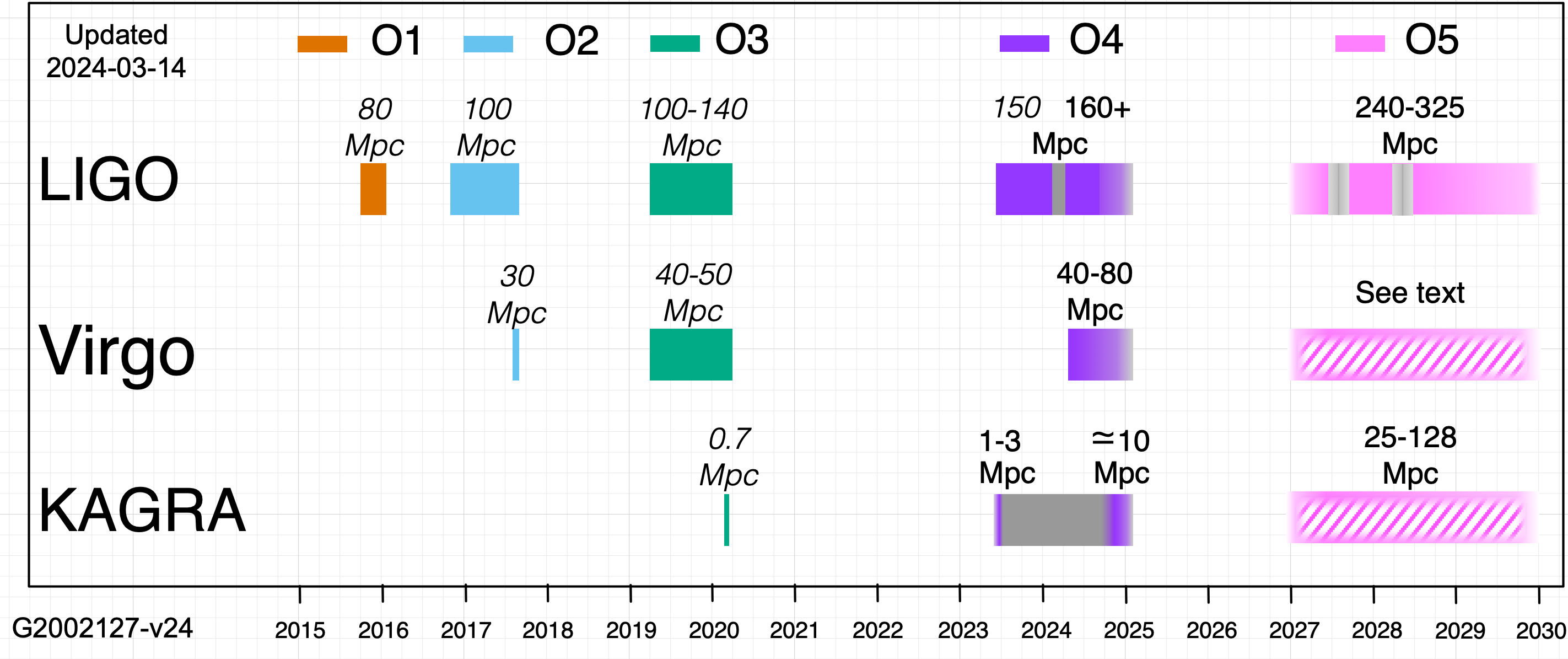
The fourth observing run (O4) of the LIGO-Virgo-KAGRA (LVK) gravitational-wave (GW) detector network ended in 2025 and a six-month IR1 observing run is planned later this year.
We have more than 200 announced detections and several more are expected to be announced soon. After interesting candidate events have been identified and their parameters have been measured, it will be time to obtain science results out of the observations. A central role played by researchers in UGent is in the Cosmology working group of the LVK. A short-term goal of this group is to measure the Hubble constant, H0, the local expansion rate of the universe. One uses the GW distance measurement together with complementary redshift information (from possible electromagnetic counterparts, host galaxies, or galaxy clusters) to infer the cosmological parameters such as H0. Due to a tantalizing discrepancy between the local and early-universe measurements of H0, now dubbed as the “Hubble tension,” such an independent measurement of H0 from the GW sector can prove to be invaluable.
Caption: The latest measurement of the Hubble constant by the LIGO-Virgo-KAGRA Collaboration; figure from [1].
In this project you will work with researchers who have developed the LVK codebase gwcosmo+ for cosmology inference and have put together the galaxy catalogues to go along with it. You will be a part of the team that carries out the first cosmology analyses on O4/IR1 data. If we are lucky, we may observe a multimessenger signal in IR1, and you will get to analyze the data from it. Until now, we have seen only one such multimessenger signal, namely GW170817.
The work involved will be computational. You will learn about statistical methods and get exposed to state-of-the-art data analysis techniques. You will be involved in a large international collaboration in the forefront field of GW science.[1] B. P. Abbott et al. “GWTC-4.0: Constraints on the Cosmic Expansion Rate and Modified Gravitational-wave Propagation,”https://arxiv.org/abs/2509.04348
Site Characterisation
Modelling the effect of Newtonian noise for the Einstein Telescope
A schematic of Newtonian-noise coupling to the test-mass. (b) Contribution of different fundamental noises to ET’s sensitivity with Newtonian noise dominating the low-frequency contributions
Newtonian noise or gravity gradient noise is an effect of the change of the Newtonian gravitational potential due to fluctuations of displacements on the surface of the Earth. Although it is a small effect for current GW detectors, it can become a major nuisance for future detectors such as the ET. Newtonian noise couples to a test mass in a manner very similar to GWs, and it is not possible, even in principle, to remove this noise source (except via active subtraction). It is therefore important to understand and quantify the impact of Newtonian noise. While estimation of Newtonian noise from homogeneous media has been well explored [1], a lot remains to be known in cases of complex, heterogeneous media.
In this project, you will analyze the generation mechanism of Newtonian noise and simulate scenarios that will best represent the contribution of Newtonian noise to ET’s low-frequency sensitivity. Simulations of elastic waves in a heterogeneous medium will be performed using a spectral finite element solver SPECFEM3D. A software library will be developed to compute the gravitational acceleration on the interferometer’s test-masses, based on the simulated displacement of the medium’s elements. In particular, focus will be given to the understanding of contributions from different parts of the medium like interfaces, and cavern walls that host the vertices of ET.
You will work in collaboration with researchers in the University of Liège, including Dr. Soumen Koley, who is one of the leading experts in modeling Newtonian noise for GW detectors.
Your results may have a significant impact in bringing the ET to Belgium!