Multimessenger searches
Gravitational waves are emitted in the inspiral and merger of two compact objects, like black holes and neutron stars, or in the explosion of massive stars. In some of these cases, we expect also electromagnetic or neutrino emission to accompany the gravitational waves. Observing a source with multiple “messengers” allows us to learn much more about the properties of the source – gravitational waves tell us how matter moves, while electromagnetic and neutrino emission tells us how the matter interacted.
At the Ghent Gravity Group, we are involved in targeted searches for such multimessenger events by LIGO–Virgo–KAGRA. Using an external trigger, we perform a deep, more sensitive, search in the gravitational-wave data in order to find evidence of a merger or explosion. Our main focus is on using high-energy neutrinos, in collaboration with the UGent IceCube group, in order to trigger the search. These high energy neutrinos can be created when protons, accelerated in the outflow of a neutron star merger or massive star explosion, interact with their environment. So far, no joint gravitational-wave/high-energy neutrino events have been detected, but a discovery would greatly improve our understanding of (some) gravitational-wave sources.
Cosmology
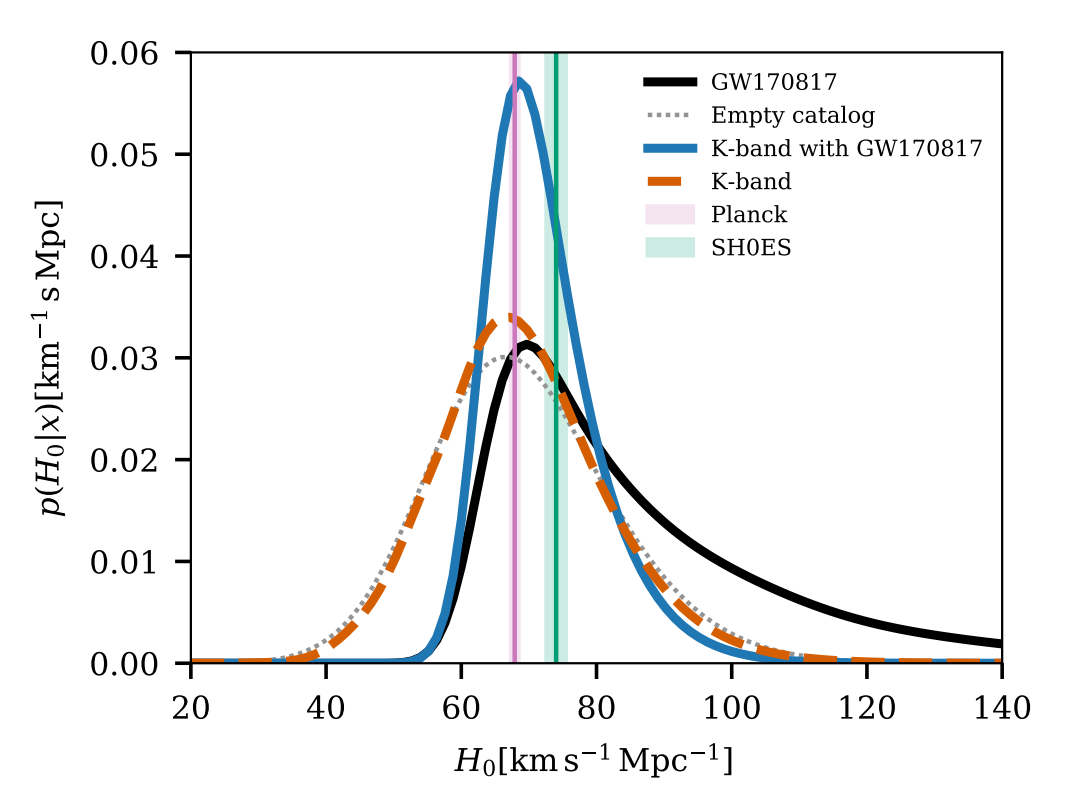
The Hubble constant is one of the most important cosmological parameters describing the expansion rate of the universe. Its accurate measurement is crucial to give constraints on cosmological models. However, as the uncertainties of the measurements shrank in the last decade it became apparent that there is a statistically significant tension between Hubble constant values measured using different methods.
Gravitational waves (GWs) provide a new, independent method to measure the Hubble constant. The GW signal from a compact binary coalescence yields a distance estimate and a galaxy catalogue provides redshift information about the possible host galaxies, which together determine the Hubble constant. Working in the Cosmology working group of the LIGO–Virgo–KAGRA Collaboration, researchers of the Ghent Gravity Group play a key role in the development and application of the new method.
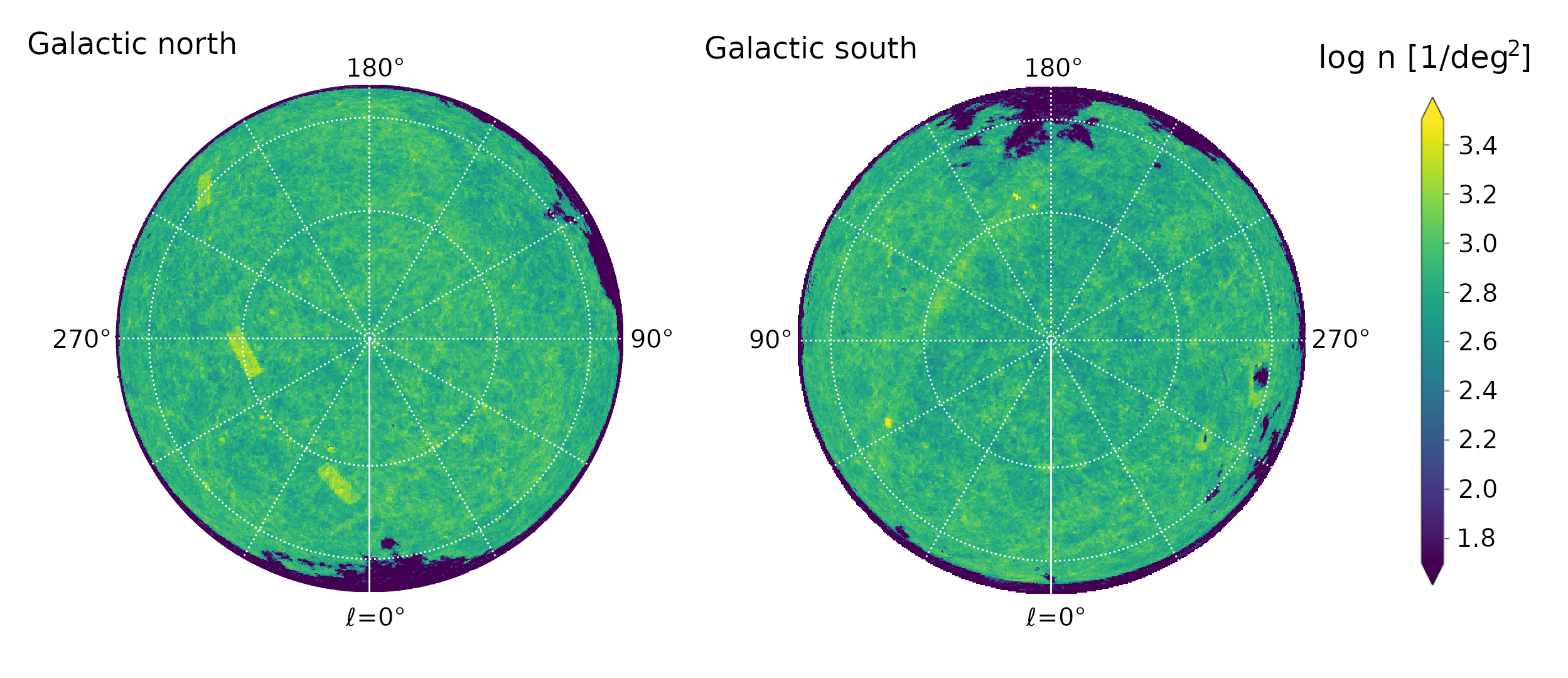
We led the development of the GLADE+ galaxy catalogue, one of the largest publicly available all-sky galaxy catalogues, which is used for the cosmological inference of the Hubble constant. Besides that, an earlier version of the catalogue, GLADE has been used by several teams to look for electromagnetic counterparts of GW detections. It also played a significant role in the multimessenger observation of the binary neutron star merger, GW170817, as most of the independent discoverers of the GW’s electromagnetic counterpart used the GLADE catalogue to optimize their efforts.
Past research